
SFDR 2.0: let’s answer your questions
Ten years after the Paris Agreement, the signing of the "Declaration on Information Integrity" at COP30 marks a turning point in the fight against greenwashing towards greater climate transparency. The proposed amendments to the Sustainable Finance Disclosure Regulation (SFDR) seek to contribute to this effort by simplifying and clarifying climate reporting for financial actors. The process of validating the amendments could take up to 18 months. In the meantime, our experts at Carbone 4 offer a nuanced analysis of SFDR 2.0 by answering your questions.
"What's changing?"
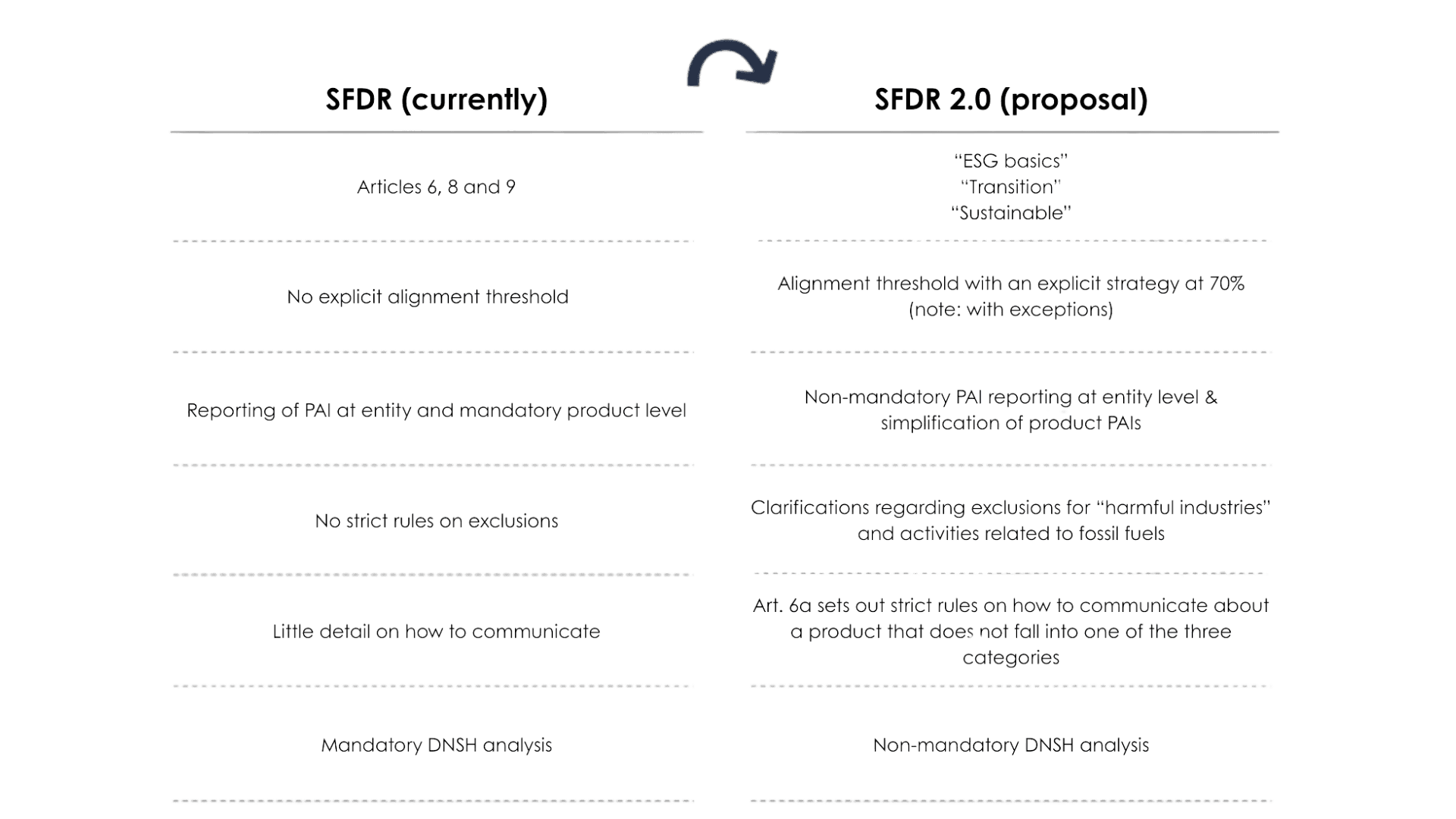
SFDR 2.0 proposes a number of changes with the stated aim of making the regulation more readable and less costly for financial players: "simplify and reduce the sustainability-related administrative and disclosure requirements” as well as “improve end-investors’ ability to understand and compare sustainability-linked financial products".
In particular:
- Three new categories are proposed to clarify the definition of "sustainable investment":
- ESG basics: "financial products integrate sustainability factors in their investment strategy beyond the consideration of sustainability risks" (Art. 8)
- Transition: "invest in the transition of undertakings, economic activities, or other assets towards sustainability" (Art. 7) with a measurable ESG transition objective
- Sustainable: "invest in sustainable undertakings, sustainable economic activities, or other sustainable assets, or contribute to sustainability" (Art. 9) with a measurable ESG contribution objective
- A minimum threshold for product alignment with one of the three categories mentioned above is set at 70%. For example, to be considered for the "sustainable" category, at least 70% of the portfolio must have a sustainability objective. N.B. There are a few exceptions to this rule, see below.
- A simplification of impact indicators or Principal Adverse Impacts (PAI). PAI reporting at the entity level is no longer mandatory, and certain PAIs for products have been simplified to better correspond to available data.
- Clarifications regarding exclusions from "harmful industries" (e.g., tobacco, controversial weapons) and subtleties by product type:
- Exclusion of "companies developing new fossil fuel projects" for the Transition and Sustainable categories
- Exclusion of "companies developing new coal-related projects" for the ESG Basics category
- Rules concerning greenwashing (Art. 6a) and how to communicate about a product that is not in one of the three categories.
- Removal of the obligation to perform a Do No Significant Harm (DNSH) analysis.
"And in my operations, what could change?"
The proposed amendments to this regulation could reduce compliance costs by 25%, which would mean savings of €163 million, especially for European SMEs, according to Les Echos[1].
SFDR 2.0 would have operational impacts in terms of reporting, marketing, and data requirements, including:
- Re-classification of current products is necessary, as well as verification of compliance with applicable thresholds and exclusion rules.
- Elimination of the DNSH analysis process for actors who have not yet implemented it, and simplification of certain processes for actors who have already implemented it, while ensuring that greenwashing does not occur, which will reduce reporting time.
- Strengthening of product sustainability analysis methodologies with clearer definitions of the objectives for "Transition" and "Sustainable."
- Cutting back on the reporting process at the entity level (i.e., at the level of the company or structure itself), which by means of contrast increases the importance of the analysis work carried out by product managers.
- Bringing marketing and communication practices (e.g., KYC, customer onboarding) into compliance with Art. 6a on greenwashing.
- Increase in demand for reliable data to align PAI data with the criteria of the three investment categories.
"What are the overlaps with other regulations?"
- CSRD: Simplifications to PAIs will need to align with those planned for CSRD ESRS in order to harmonize data collection requirements and, in particular, to be consistent with data requirements for transition plans.
- MIFID II: This directive regulates the provision of financial services to better suit investor profiles. The questionnaires that financial institutions provide to their clients regarding their investment criteria preferences will need to be updated to incorporate the new three-category classification.
- European Green Taxonomy: Alignment with the green taxonomy categories is an integral part of identifying products that are aligned with the three categories.
"In terms of climate ambition, are these changes a step in the right direction?"
Firstly, we welcome the efforts to redefine "green investment" with clearer categories. In addition, SFDR 2.0 strengthens the exclusion criteria, particularly for the "transition" and "sustainable" categories, which are aligned with those of the Paris-Aligned Benchmark (PAB)[2]. The removal of DNSH analysis could therefore be partially offset by compliance with these exclusions. Moreover, the transition plan remains a key indicator for SFDR 2.0 (it has not been removed from the PAIs), which encourages concrete action. These elements reflect a real effort to combat greenwashing, as explained in Article 6a.
However, we would like to qualify certain proposals and highlight their limitations:
- The removal of entity-level reporting could create inconsistencies in terms of sustainability strategy governance (if product objectives differ from those of the entity) and fail to provide the necessary transparency for investors. Financial actors could also lose some of their responsibility for managing the negative impacts of their investments. In practice, we will monitor whether entities that already report at the entity level will continue to do so.
- The rules on exclusions still leave room for investment in unsustainable activities. For example, the "ESG basics" category is not subject to the same rules on excluding fossil fuel activities, as the other two categories.
- The minimum threshold of 70% is vague in terms of the criteria chosen. For example, a "transition" fund can have 70% of its assets considered to be in "transition" (thanks to companies with annual emissions reductions, internal climate policies, or other factors) and invest the remaining 30% freely. Furthermore, it has not been demonstrated whether this 70% threshold is high enough to mitigate climate risks. Finally, an exemption from this threshold in the "transition" and "sustainable" categories is possible if the fund can demonstrate at least 15% alignment with the European green taxonomy. For certain assets, such as infrastructure funds, achieving 15% alignment with the taxonomy is relatively feasible, and the remaining 85% could be invested in non-aligned highways or airports. This exemption seems inconsistent with the objective of supporting the EU's "transition" (according to Morningstar Sustainalytics[3], the alignment rate of non-financial companies with the taxonomy was only 12.9% in 2023). In order to give due recognition to financial players that are committed, this exemption should be removed, the 15% alignment threshold with the taxonomy should be significantly raised, or the threshold should be differentiated according to asset classes.
- The scope of SFDR 2.0, which is not exactly aligned with other regulations, could create areas of reporting uncertainty. For example, MiFID II includes structured products, which is not the case with SFDR 2.0.
- The scope of Article 6a., which aims to regulate the communication of "unclassified" financial products (not falling into any of the three categories) in order to prevent greenwashing, becomes less clear with the introduction of Article 9a**.** Article 9a opens up the possibility for "unclassified" products to make specific claims related to the three SFDR 2.0 categories without having to comply with all the substantive requirements associated with those categories, particularly with regard to exclusions. To avoid this ambiguity, SFDR 2.0 should require that any fund making claims based on SFDR categorization apply the exclusions of the relevant categories to all its assets.
- The "ESG basics" category still appears to be very heterogeneous and insufficiently defined. For example, an "ESG basics" product with a "best-in-class" strategy without minimum standards could include unsustainable activities.
- The range of green products on offer will be impacted in a nuanced way. A Morningstar study[4] predicts that the share of products currently classified as "Article 8" could fall dramatically with these stricter SFDR 2.0 rules for the "Transition" or "Sustainable" categories. The majority of these products would end up in "ESG basics" or unclassified. The study also anticipates a slight increase in products currently classified as "Article 9" or which could end up in the "Sustainable" or "Transition" category in the future.
- The methodologies for complying with SFDR 2.0 are not yet sufficiently explicit. Internal methodologies relating to "sustainable" and "transition" strategies must continue to be strengthened, with clearer definitions for objectives and reporting indicators. Today, many financial players assess companies' transition plans (and this demand is growing) using internal methodologies, in coordination with firms such as Carbone 4, using indicators relating to emissions (scopes 1, 2, and 3), decarbonization targets aligned with the Paris Agreement, and the distribution of investments ("sustainable," "fossil," "gray," etc.). In our view, SFDR 2.0 should link the eligibility criteria for the "transition" and "sustainable" categories more closely to best practices already developed by the market, in order to make reporting more operational and therefore useful for financial players. This will also help to highlight those players who are already moving in the right direction.
“So, what happens next?”
The trilogue, discussions between the European Parliament, the Council of the EU, and the European Commission, could take up to 18 months before the SFDR 2.0 regulation is adopted for use. In particular, we are awaiting clarification on several key points of the SFDR 2.0 framework, including the final list of exclusions by category, clear eligibility criteria applicable to each category, and the functioning of the 70% threshold exemption in cases where at least 15% of the portfolio is aligned with the green taxonomy. Clarification is also needed on the exact scope of the SFDR obligation, the guidelines on anti-greenwashing communication for unclassified products, and the reference methodologies to be used for related reporting.
To be continued!
External contributors:
- Virginie Wauquiez, CEO - Carbon4Finance,
- Lucie Mauzé, Climate and Biodiversity Data Sales - Carbon4Finance.
Other resources that might interest you























Contact us
Contact us about any question you have about Carbone 4, or for a request for specific assistance.